
Reference Books
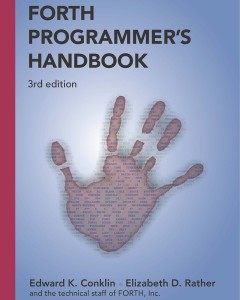
Forth Programmer’s Handbook
Forth Programmer’s Handbook has earned its reputation as the de facto ANS Forth reference manual, regardless of which Forth implementation you use. It includes extensive Forth language glossaries, as well as generous, lucid discussion of both common and advanced programming subjects.
Buy on Amazon
Available exclusively through our publishing partner Amazon.com.
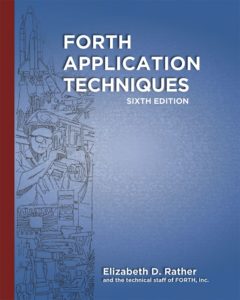
Forth Application Techniques
Forth Application Techniques helps you learn practical Forth programming from basic to advanced. It introduces Forth fundamentals and assigns building-block exercises that develop a good general knowledge of using the Forth programming language to create software solutions.
Buy on Amazon
Compatibility: This book’s code examples and exercises will run on most standard-compliant ANS Forth systems, including our free-trial SwiftForth for Windows, Linux, and macOS.
Available exclusively through our publishing partner Amazon.com.
Brodie Fans:
Still Relevant, Still Valuable and Now They’re Free!
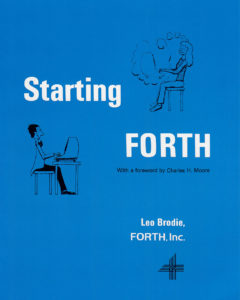
Starting Forth by Leo Brodie
This classic Forth tutorial book, first published in 1981, has been updated so the code exercises and examples run on modern Standard Forth systems like SwiftForth® and iForth. Most of the original hand-drawn illustrations have been restored and still are surprisingly effective at easing beginning Forth programmers — including some who have never written any code at all — from simple concepts into core techniques. Many of today’s leading Forth developers started with this whimsical, deft, Forth tutorial.
Complete, free, online edition
Don’t have a Forth system? You can download and install the SwiftForth evaluation version (Windows, macOS, or Linux) to do the exercises in this book.
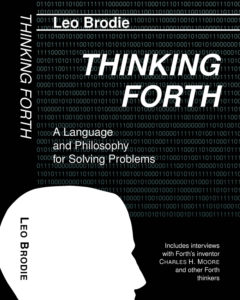
Thinking Forth by Leo Brodie
“A Language and Philosophy for Solving Problems”
This book handles the difficult subject of how to think about problems and their solutions. It helps the reader, who knows some Forth and can put words together, shift into a more expert mode. The concepts go beyond Forth, but the simple beauty of Forth throws those concepts into stark relief. The book includes interviews with Forth’s inventor, Charles Moore, and other Forth thinkers.
Thinking Forth project on SourceForge
Updated 2004. First published in 1984, for many years this book was the sole and reliable companion to the tutorial Starting Forth, by the same author. A few obligatory illustrations are included but this book is not a Forth tutorial.
ANS/ISO Forth Standard1
This final draft2 of the ANS Forth-1994 Standard is not for beginners or even for most programmers. It describes, in minute detail, the standard behavior of the Forth programming language. It is of greatest interest to language implementors and theorists, and to those concerned with certain compliance issues.
Forth-1994 Standard [1.1 MB PDF]
1. On the international front, ANS Forth was ratified shortly thereafter in the form of the virtually identical ISO/IEC 15145:1997 Information technology — Programming languages — Forth.
2. In the event of conflict, only the officially printed document X3.215-1994 represents ANS Forth. To purchase a copy, contact the American National Standards Institute’s sales department at (212) 642-4900 or FAX (212) 302-1286; or Global Engineering Documents at (800) 854-7179 or by FAX to (303) 843-9880 requesting Document X3.215-1994.